


This article is part of our Building Your Title IX Team series, which explores the critical roles that ensure a fair, compliant, and defensible Title IX process. In this installment, Adrienne Mathis offers real-world guidance for Title IX Coordinators.
Being a Title IX Coordinator means balancing legal requirements, institutional expectations, and the very human realities of the work, often alongside another full-time role. Whether you’re new to the position or have years of experience, every case brings its own challenges—and the process doesn’t always move in a straight line.
What makes the difference is having the right tools, clarity, and support to navigate those gray areas with confidence. This article explores common pressure points coordinators face, practical guidance for the role, and coordinator mentorship—a form of hands-on support you may not be familiar with.
Managing Expectations Across Campus
Title IX coordinators often serve as the primary point of contact for parties, campus partners, and institutional leadership. Expectations can be high, timelines are closely watched, and communication carries real weight.
Clarity plays a central role in maintaining trust throughout the process. When expectations are set thoughtfully and reinforced consistently, coordinators are better positioned to manage uncertainty, even when circumstances change or timelines extend.
Balancing Case Management and Compliance
For many coordinators, Title IX responsibilities exist alongside other roles. When there are no active cases, preparation can be difficult to prioritize, yet when a report arrives, the work becomes immediate and complex.
This tension makes readiness especially important. Coordinators who feel grounded in their role and aware of available support are better equipped to move into action when demands escalate.
Navigating Title IX Regulatory Uncertainty
The current Title IX landscape is shaped by shifting guidance and less clarity from federal authorities. Changes within the Department of Education and the evolving role of the Office for Civil Rights have made it harder for institutions to rely on consistent signals about enforcement, even as expectations around compliance remain high.
At the same time, coordinators are navigating real legal and reputational risk. Private litigation remains a significant concern, and confusion persists as the 2024 Title IX regulations, though rescinded, still appear in federal resources while the 2020 Title IX regulations remain in effect. In this environment, coordinators must be grounded in the framework that applies to their institution, knowing when to ask questions, dig deeper, and avoid relying on a single source of guidance.
“Your institution’s policy is the guidebook for the Title IX process. If there are problems with the policy, it’s important to flag those issues and address them.“
The Title IX Coordinator Role at a Glance
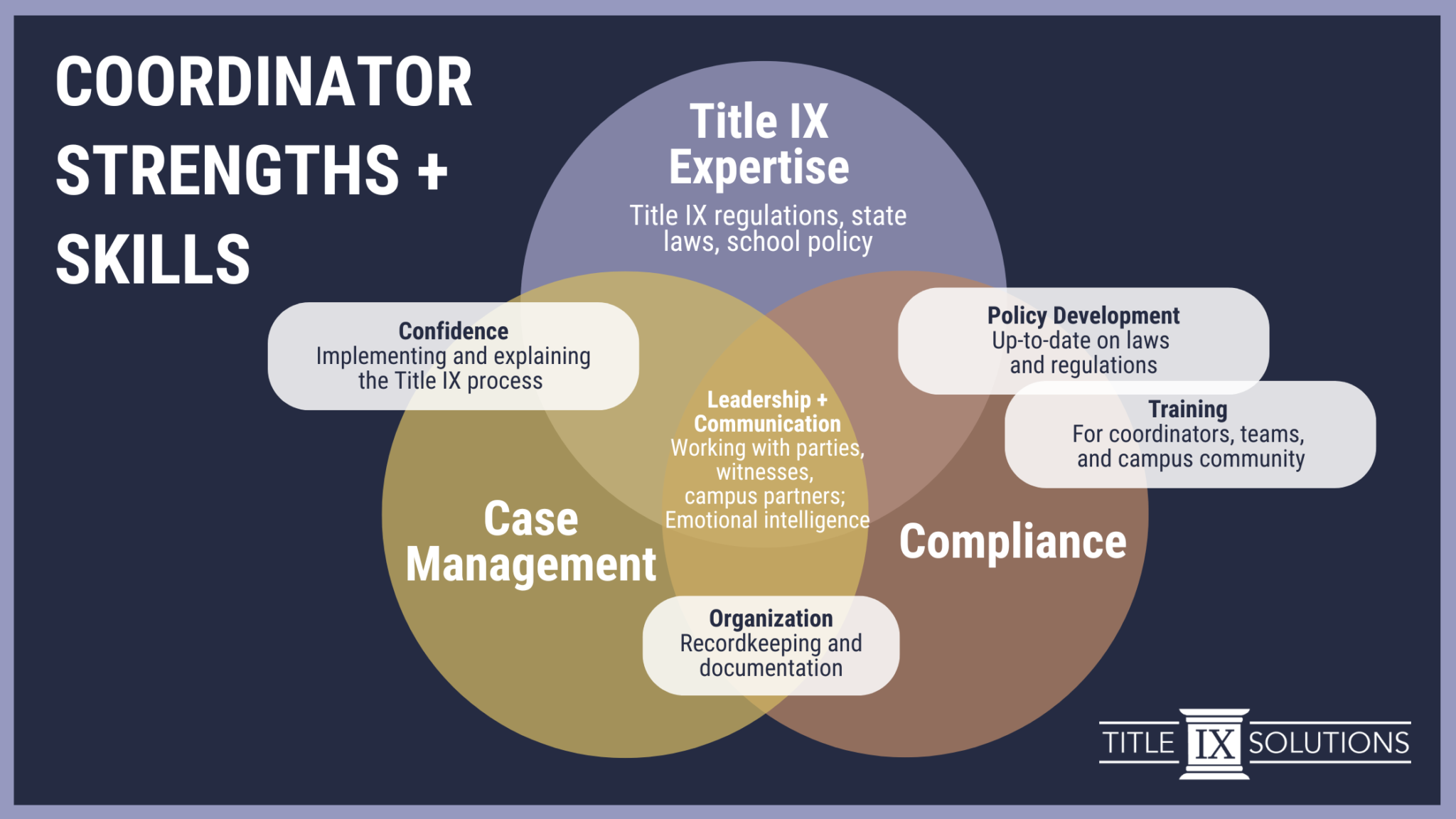
Actionable Guidance for Title IX Coordinators
Know your policy
Your policy is the foundation of the Title IX process. Understanding your institution’s policy, the applicable Title IX regulations, and relevant state law—and how they’re reflected in the policy itself—is essential to implementing the process effectively.
If something doesn’t align, it’s important to flag those issues early and raise questions with the appropriate campus partners. Addressing policy gaps or inconsistencies before a case progresses can help prevent challenges later in the process.
Prioritize training as an ongoing foundation
Training is required, but it also provides the baseline knowledge you rely on when cases become complex. Understanding the regulations, your institution’s procedures, and your role within the process helps you respond with greater confidence and consistency.
If you’re looking to build or refresh that foundation, the IX Institute offers a range of role-specific Title IX courses designed to support coordinators at different experience levels.
Understand your role
The Title IX coordinator role requires a broad range of skills, including organization, attention to detail, communication, leadership, and emotional awareness. Coordinators serve as the central point of coordination for parties, investigators, decision-makers, campus partners, and leadership.
Understanding the breadth of this role can help you identify where you feel most confident and where additional support or development may be helpful over time.
Build a professional network
Other coordinators, regional associations, consortiums, and experienced Title IX professionals can offer valuable perspectives. Many challenges are shared, and learning from others’ experiences can help reduce uncertainty and strengthen decision-making.
Connecting with peers in similar roles at comparable institutions, particularly within your region, can be a helpful starting point. Live, virtual Title IX webinars and trainings offer opportunities to learn from others doing this work. You can also sign up here to stay informed about our upcoming live webinar offerings.
If you’re interested in expanding your network and aren’t sure where to start, you’re welcome to reach out to us at info@titleixsolutions.com.
Use available resources
There is a wide range of free Title IX content available, including articles, webinars, and practical guidance. Engaging with these resources—especially during quieter periods—can help you stay informed and prepared.
We regularly share free, practical guidance and insights in our Title IX articles and on-demand webinars.
Set expectations clearly
Setting expectations isn’t just important with institutional leadership. It also matters for parties, employees, families, and others involved in the process. Clear communication about timelines, procedural steps, and what comes next can reduce confusion and help everyone understand that the process is moving forward as required.
Proactive coordination can make this easier. Regular check-ins with investigators and decision-makers, such as requesting brief weekly updates, can help you track progress and anticipate next steps. Having a clear sense of where a case stands makes it easier to provide meaningful updates and helps shift conversations from crisis management to informed planning.
One-on-One Mentorship for Title IX Coordinators
Even with training and experience, many coordinators find that the most challenging part of the role is implementing the process as it unfolds. Cases rarely follow a predictable path, and questions often arise that require judgment beyond what’s written in policy.
Coordinator mentorship is designed to support coordinators in those moments. It provides hands-on, case-based guidance focused on implementation, communication, and navigating the gray areas that can emerge during a case. Unlike one-off consulting, mentorship offers support throughout the life of a case—from intake through resolution and appeal—so coordinators aren’t navigating complex situations alone.
Learn more about Coordinator Mentorship →